“Taking Out the Trash” – Or Dumping it on the Neighbors? Our Research Featured in Ynet News

Link

We are excited to share a new feature in Ynet News covering the latest discovery from the Glickman Lab!

The article, “Israeli scientists reveal how brain ‘takes out the trash’, and may spread Alzheimer’s,” highlights our recent study led by Prof. Michael Glickman and postdoctoral fellow Dr. Ajay Wagh (published in PNAS).

The findings: We discovered that in Alzheimer’s disease, brain cells don’t just accumulate toxic proteins—they actively expel them. While this survival mechanism saves the individual cell, it effectively “dumps the trash” on neighboring neurons, causing the disease to spread across the brain.

As Prof. Glickman explains in the interview:

“We all want someone to take out the trash… But in this case, the cells are dumping their trash on their neighbors. Although this solves an acute problem for the individual cell, it may cause long-term damage to the entire tissue.”

This insight opens new doors for early diagnosis via cerebrospinal fluid and suggests new therapeutic strategies targeting this disposal pathway.

New Review Published: “The many faces of p97/Cdc48 in mitochondrial homeostasis”

Link

We are proud to announce the publication of a comprehensive review article by lab alumnus Dr. Jonathan Ram in Essays in Biochemistry.

In the article, titled “The many faces of p97/Cdc48 in mitochondrial homeostasis,” Dr. Ram provides an integrated overview of the critical AAA+ ATPase p97. The review highlights p97 as a central hub that coordinates essential cellular processes to maintain mitochondrial health, including:

  • Protein Quality Control: regulating mitochondria-associated degradation (MAD) pathways.

  • Mitochondrial Dynamics: influencing fusion, fission, and mitophagy.

  • Cell Fate: orchestrating apoptotic signaling.

Understanding these diverse “faces” of p97 is crucial, as its dysfunction is linked to severe multisystem degenerative disorders.

“Three Who Know” – Prof. Michael Glickman Discusses Novel Alzheimer’s Propagation Mechanism

We are pleased to share that the head of our laboratory, Prof. Michael Glickman, was recently featured on the radio program “Three Who Know” (שלושה שיודעים) on Kan Culture.

During the interview, Prof. Glickman discussed our lab’s latest findings regarding the progression of Alzheimer’s disease. Challenging the traditional view that toxic proteins merely accumulate intracellularly, Prof. Glickman explained how stressed neurons actively secrete these toxic components to the extracellular space.

New article in PNAS

Link to the article

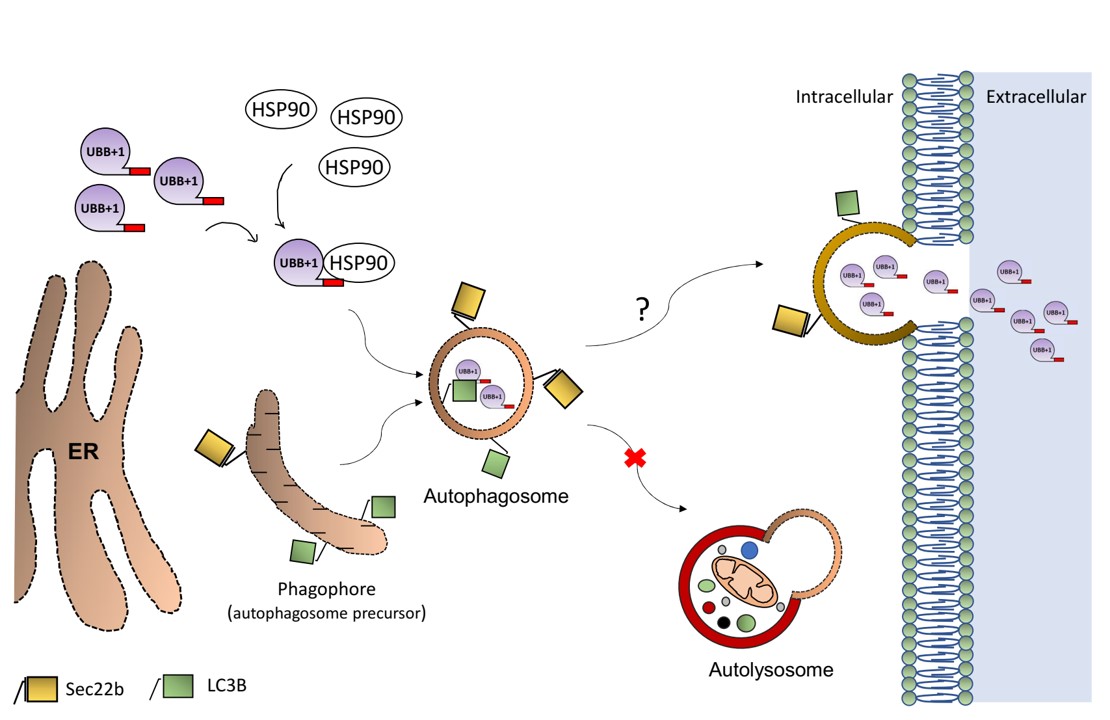
In our recent study, we explored how neurons cope with toxic, misfolded proteins—an especially important question since these cells can’t simply divide to replace damaged ones. We found that, beyond its traditional role in degrading unwanted proteins, the autophagy pathway can also export harmful protein variants. Specifically, we showed that the Alzheimer-associated ubiquitin variant UBB+1 is recognized by the autophagy adaptor p62, packaged into vesicles, and secreted from cells. When p62 is missing, UBB+1 instead accumulates inside neurons, increasing proteotoxic stress. These findings identify UBB+1 as a new cargo for secretory autophagy and broaden our understanding of how cells manage protein quality to maintain neuronal health.

Well done to Ajay R. Wagh for a wonderful and insightful research!


New article about mutant Ubiquitin (UBB+1) secretion

When intracellular trash disposals overflow with misfolded proteins, cells may dump the excess onto their neighbours’ doorsteps.

Happy to share our recent work published in the BBA-Gene Regulatory Mechanisms journal.
Do give it a read: Alzheimer’s disease-associated mutant ubiquitin (UBB+1) is secreted through an autophagosome-like vesicle-mediated unconventional pathway.

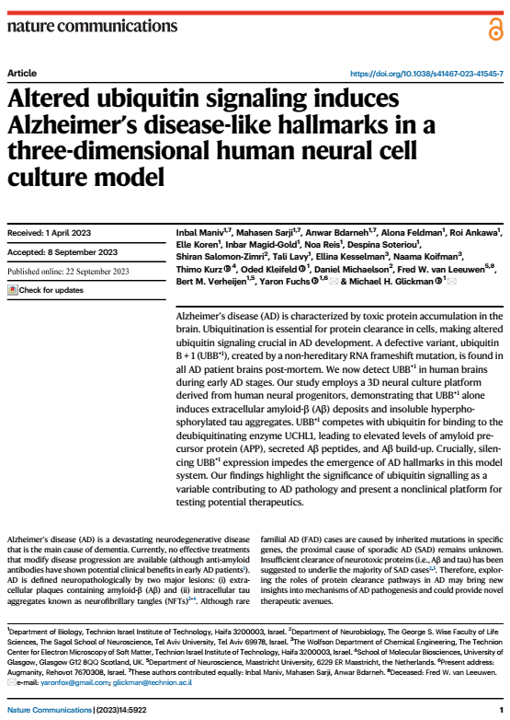
Here we present evidence that an altered form of ubiquitin, UBB+1, arising from a non-
heritable transcription frameshift, and has been identified in the brains of all FAD and SAD patients, is unconventionally secreted via “autophagosome-like vesicles”.

Our findings bring critical insight into the molecular mechanism of Alzheimer’s pathogenesis and how advancing age and diminishing proteasomal function is a risk factors.

New article in Nature Communication

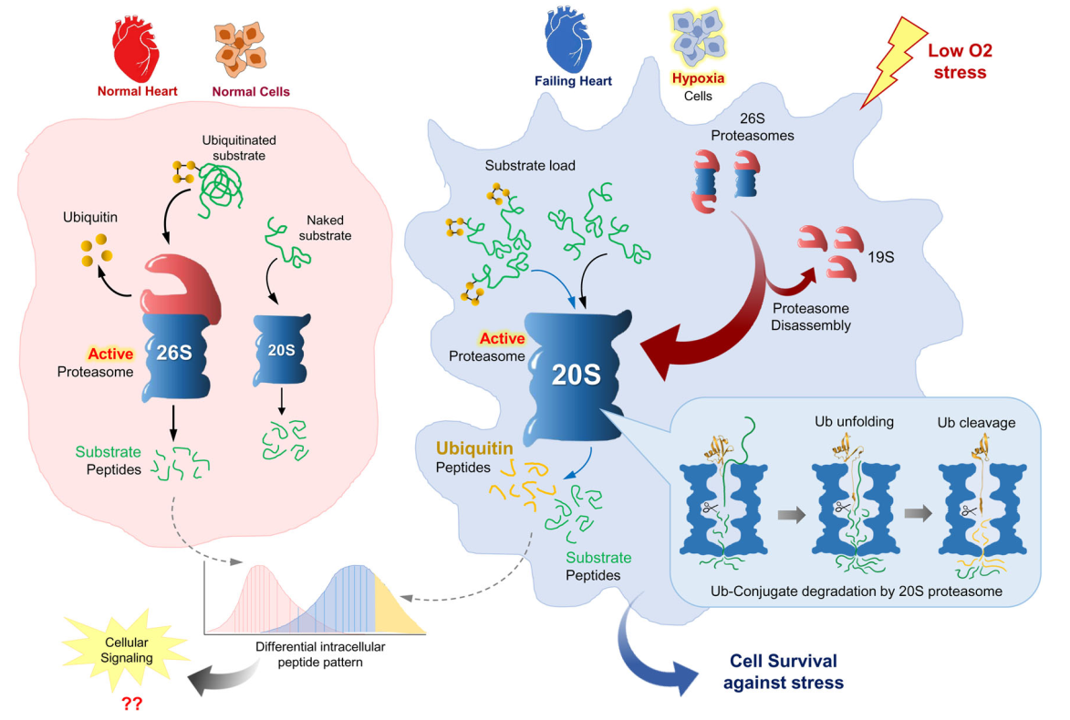
Kudos to Indrajit and the team for our new article in Nature Communications describing The 20S as a stand-alone proteasome in cells can degrade the ubiquitin-tag” 

A model demonstrating the putative contribution of 20S proteasomes to proteolysis during hypoxia.

Under normoxia, the 26S proteasome degrades proteins and recycles the conjugated ubiquitin tag. Disassembly of 26S proteasomes under hypoxia leads to elevated levels of free 20S core particles (CP). Excess-free 20S CP are proposed to serve as active proteasomes capable of degrading a portion of ubiquitin along with the conjugated substrate. The disordered segment of the substrate inserts into the gate at the center of the 20S α-ring and accesses the proteolytic active sites until the ubiquitin domain is localized to the pore. Stepwise protease-driven unfolding of ubiquitin brings the conjugation region to the vicinity of the β-proteolytic active sites. Ubiquitin is proteolyzed and peptide products from both substrate and ubiquitin are released, occasionally including a remnant of ubiquitin still linked via an isopeptide bond to a substrate-derived peptide.